

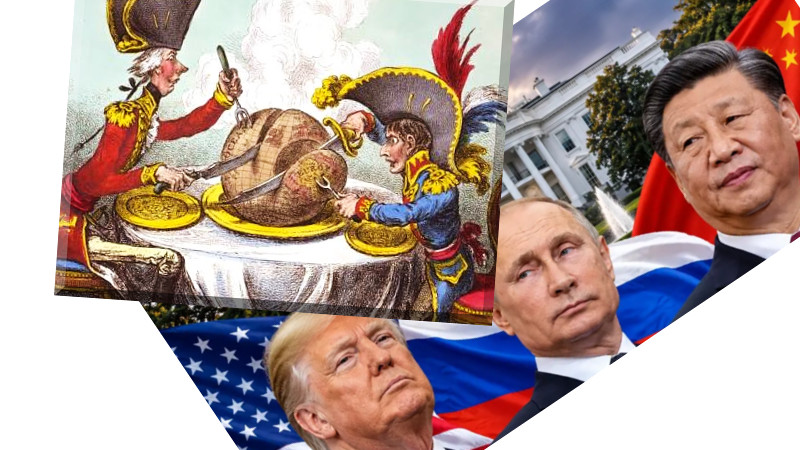
On Thursday (Nov 19.), Donald Trump, Xi Jinping, and Vladimir Putin will meet in Shenzhen. It will be the first time the three have sat down together. Everyone is calling it Yalta II.
(In the picture: William Pitt Jr., Napoleon Bonaparte, Donald Trump, Vladimir Putin, Xi Jinpin.)
The comparison is tempting: three great-power leaders, one table, and the fate of others on the agenda. But it’s misleading. The men who met at Yalta in February 1945 had armies in the field and a war nearly won, so they could impose what they decided. The men meeting in Shenzhen cannot carve up the world, not unless the rest of the world lets them.
’Return to nineteenth-century power politics’
The real danger lies elsewhere. All three leaders are comfortable with a return to nineteenth-century power politics, a world of great powers and spheres of influence where the strong do what they can and the weak suffer what they must. But they do not play the game equally well.
In Shenzhen, Putin and Xi will take Trump’s measure. They will flatter him and maybe give him some wins, but then get on with exploiting his weakness to get their own way.
One worldview, two kinds of strategy
Putin’s ambitions are the oldest. Last week in Abu Dhabi, Russian negotiators handed Trump’s envoys a non-paper that revived, in some cases word for word, the demands Moscow made two months before it invaded Ukraine.
NATO needs to pull its forces back to where they were in 1997. Britain and France must rule out using their nuclear weapons to protect other Europeans.
What Putin wants: His ’empire’ back
The Russians even held up the Cold War and the Warsaw Pact as a model for postwar Europe, arguing that separate U.S. and Soviet spheres had made the continent safer. After five years of war and hundreds of thousands dead, Putin wants what he has always wanted: his empire back.
Trump: A return to nineteenth-century power politics and spheres of interest
Trump’s ambitions are the most surprising and, for America’s friends, the most unsettling. As Jim Lindsay and I wrote when he returned to office, Trump envisions a return to nineteenth-century power politics and spheres of interest. His National Security Strategy turned his desire into doctrine:
“The outsized influence of larger, richer, and stronger nations is a timeless truth of international relations.”
Metternich couldn’t have put it better. The strategy seeks to make the Western Hemisphere America’s own, adding an offensive “Trump Corollary” to what originally was a defensive ’Monroe Doctrine’. Trump has threatened Canada and Greenland. He sees Putin and Xi as peers and America’s allies as free riders.
Xi shares the worldview, but he alone of the three also thinks in twenty-first-century terms. In March 2023, standing at the Kremlin door, Xi told Putin that “right now there are changes – the likes of which we haven’t seen for 100 years – and we are the ones driving these changes together.”
China’s navy, now the world’s largest by number of ships, is the most visible sign. But Xi’s real strategy is to dominate the markets that will define this century. China controls the world’s supply of rare earths and has shown a willingness to control it to its own ends. It installs more industrial robots than the rest of the world combined. Its open-weight AI models are now the world’s most downloaded. It makes most of the world’s solar panels, batteries, and electric cars, and it is pouring money into quantum computing.
Trump and Putin are men of oil. Xi is betting on sun and wind. Two of them are fighting over the last century’s sources of power. The third is building the next century’s.
The trade: So what can we expect in Shenzhen?
Trump will likely get a win or two. Expect a trade truce, perhaps big Chinese purchases of American soybeans, and maybe even talk of nuclear arms control. If Kim Jong Un plays along, and a Trump trip north of the DMZ remains a possibility, Trump may get the biggest photo op of all: a peace deal ending the Korean War. All three of his counterparts would welcome that.
A peace treaty would strip the UN Command of its legal basis and raise the obvious question of why U.S. troops remain in South Korea. Trump’s own defense strategy already draws America’s line at the First Island Chain, which leaves Korea on the inside. And Xi and Putin will be fine cheering along as Trump makes claims on his own hemisphere and talks of the three of them settling the world’s affairs.
Nobody but Trump will mistake these for real wins. Certainly not American voters, who have stopped believing him.
What Putin and Xi get is more valuable. They get a close-up read of a president who wants a win more than he wants anything else. Officially, Ukraine is off the trilateral agenda.
But Putin first proposed this meeting to talk about Ukraine, and the Kremlin still says he and Trump will discuss a settlement in Shenzhen. It’s an enticing prospect for both men: settling the future of Ukraine and Europe while neither is there. That explains the Yalta fear.
Xi, meanwhile, will gauge how hard Trump would resist his designs on Taiwan and the waters of the South China Sea he seeks to make his own. Together, Russia and China will press their neighborhoods and stretch a United States, bogged down in the Middle East, past its limits.
The next two years will likely be the period of maximum danger. Both Putin and Xi see a window that may soon close.
Putin knows time is not on his side in the long run. Russia’s economy is strained, its population is shrinking, and Europe is rearming. But in the short run, with Trump in the White House, America distracted by its war with Iran, and Europe not yet ready, Putin believes time is on his side. He is pummeling Ukraine in the hopes it will cave during a brutal winter. And then he may move against Europe. He has every incentive to press his advantage before the balance shifts.
Xi’s window may close
Xi’s calculus runs the other way, but it points to the same moment. China’s power is still rising. But once America’s allies in Asia rearm and the United States enters the post-Trump era, Xi’s window may close.
Kevin Rudd, among the sharpest analysts of Xi’s reign, argues that 2028 is the year to watch. China’s military exercises around Taiwan have grown into full-scale rehearsals for a blockade or invasion. Taiwan’s January 2028 election could provide a trigger. And Xi, Rudd believes, has concluded that Trump would not respond militarily if China moved. He puts the odds of a Chinese move in 2028 at one in three. That is Trump’s last full year in office.
Putin may fail, Xi may succeed
Shenzhen will feed that confidence. Every time Trump comes to Xi seeking a deal, Beijing’s sense that it holds the stronger hand is reaffirmed. That is how deterrence erodes.
Of the two, Putin holds the weaker hand. Europe is rearming. Nearly every country sees the threat Russia represents. And most are determined to support Ukraine to the maximum extent. Russia, meanwhile, is losing an average of 50,000 men over the last two months — more dead and wounded in the past six months than the US suffered during the entire Vietnam war.
Ukraine is suffering greatly, not least in cities ravaged by missile strikes; but it is fighting back — taking more than 50 percent of Russia’s refining capacity offline and steadily weakening Moscow’s access to and hold over Crimea. Together, Europe and Ukraine can make sure Putin’s gambit fails.
Xi: Nineteenth-century spheres in Asia
Xi is a different matter. He is playing both games at once: nineteenth-century spheres in Asia, backed by twenty-first-century dominance in the industries that will decide who leads in the future. Stopping him will take more than Europe. It will take Asia’s democracies, the world’s middle powers, and, eventually, a United States that remembers why alliances matter.
The rest of the world is not powerless. Unlike in 1945, others have agency, if they choose to use it.
Europe has taken a first step. In Dublin last Friday (13.11.), EU leaders agreed that Europe will be represented in Ukraine peace talks by the EU institutions together with France, Germany, the UK, Italy and Poland. Good. But knowing who sits at the table is not a strategy.
What the moment demands is a real middle-power strategy. Mark Carney laid out the logic at Davos in January: “The middle powers must act together because if we are not at the table, we are on the menu.” Europeans applauded. Now they need to act.
That means three things. First, close the window. If the next two years are the period of maximum danger, the task is to make them less dangerous.
In Europe, that means giving Ukraine what it needs to get through the winter and keep bleeding Russia’s war machine, and making clear that any move against a NATO ally will meet a collective response, with or without Washington.
In Asia, Japan, South Korea, Australia, and the Philippines must deepen their own defense ties so that Beijing cannot bank on American hesitation alone.
Second, compete where Xi is strongest. No middle power can match China’s industrial machine on its own. Together, they can pool markets, capital, and technology so they don’t depend on Beijing for rare earths, batteries, or AI. And they need to write the rules for trade and technology that China and the United States no longer will.
Third, keep the door open. Trump won’t be president forever. The alliances and institutions the middle powers preserve now are the ones a post-Trump America can and should rejoin.
Trump respects power. So do Xi and Putin. Together, the middle powers have plenty of it: the economic weight, the technology, and increasingly the military strength. What they have lacked so far is the will to use it together. If Shenzhen doesn’t convince them, nothing will.
America Abroad, Nov 17. 2026 
Other News:
10.11. 2026:
Turvallisuusmullistus Persianlahdella: Uutta orientaatiota haetaan -ensin keskinäisesti- sitten??
25.10. 2026:
27.08. 2026:
18.07. 2026:
11.08. 2026:
08.07. 2026:
Äärikonservatiivit -kolmessa pääkaupungissa-haluavat jatkaa Persianlahden sotaa
23.12. 2025:
15.06. 2026:
10.10. 2026:
Atte von Wright: Mietin joutolauantaihin sopivaa aihetta, Donald Trumpin älykkyysosamäärää
22.06. 2026:
16.05. 2026:
09.04. 2026:
15.08. 2026:
Kiinan rahaa Palestiina-aktivismiin, -ja kenen muun ja mihin?
15.05. 2026:
Kiinassa kuukin on kuumempi: Venäläinen näkemys kohuvierailusta
27.01. 2026: